
If your sitemap is missing pages, contains duplicate URLs, generates incorrect links, or behaves unexpectedly, OSMap's built-in debugging tools can help you identify the cause.
OSMap provides two debugging modes:
- HTML Debug, which displays detailed information about every sitemap item.
- XML Debug, which displays the raw XML generated by OSMap.
This guide explains how to enable both debug modes and how to interpret the information they provide.
How to Enable HTML Debug
- Go to Menus > Your Menu.
- Edit your OSMap HTML Sitemap menu item.
- Open the Sitemap Settings tab.
- Set Debug to Yes.
- Save the menu item.
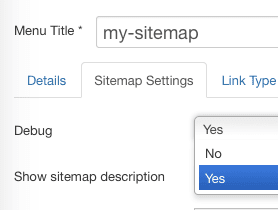
Now open your HTML sitemap in the front end. Instead of the normal sitemap, OSMap displays detailed debugging information for every sitemap item.
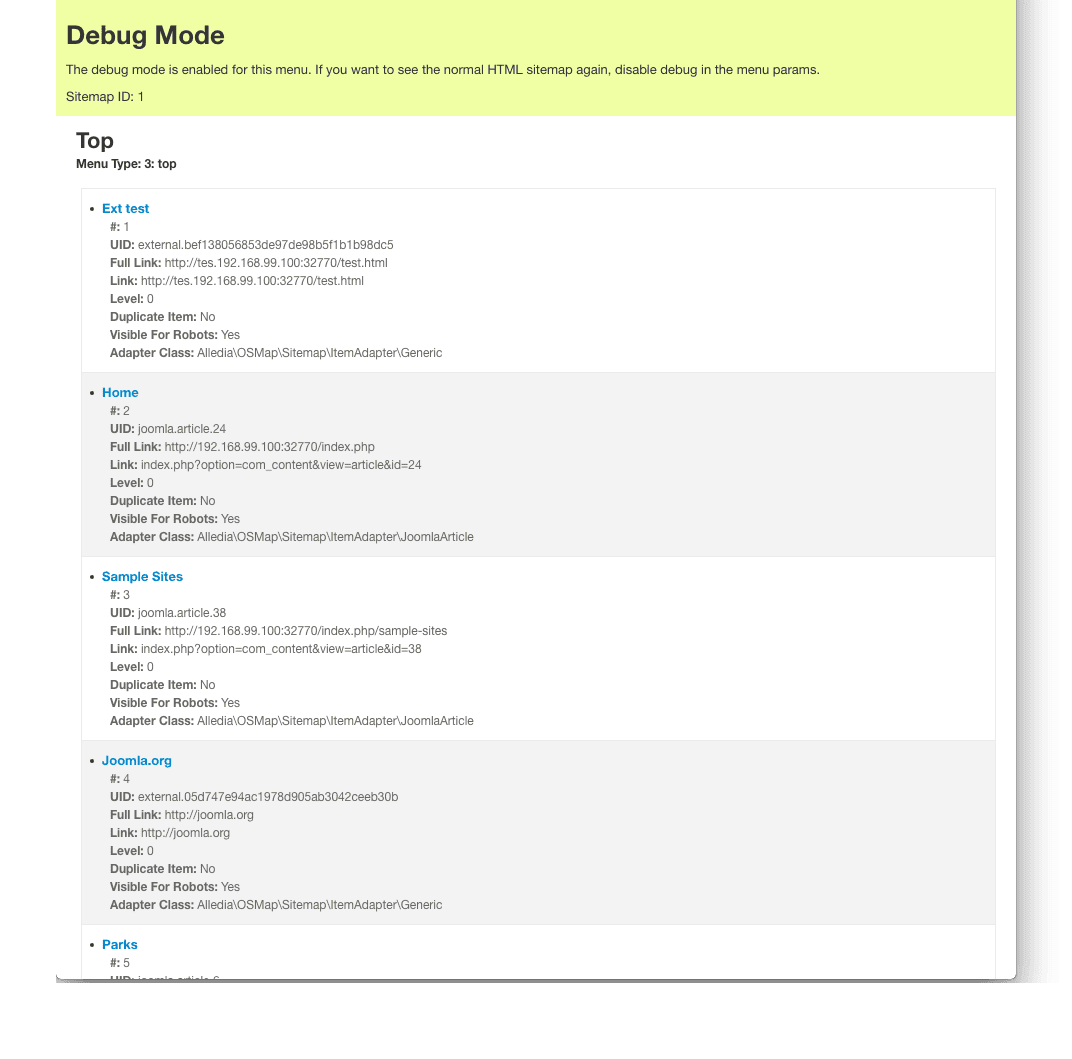
Understanding the HTML Debug Output
Each sitemap item includes technical information that can help identify routing problems, duplicate links, missing metadata, and compatibility issues with third-party extensions.
Understanding the HTML Debug Output
Each sitemap item includes technical information that can help identify routing problems, duplicate links, missing metadata, and compatibility issues with third-party extensions.
UID: The unique identifier assigned to the sitemap item. This information can be useful when reporting problems to Joomlashack Support.
Full Link: The final URL that visitors and search engines will access. Verify that this is the URL you expect to appear in your sitemap.
RAW Link: The URL before Joomla applies Search Engine Friendly (SEF) routing. This is useful when investigating routing or SEF-related problems.
Link: The internal Joomla route used to generate the page. This can help identify menu routing issues.
Modified: The page's last modification date. If this value is missing or incorrect, search engines may not recognise when the page has been updated.
Level: Shows the page's position within the sitemap hierarchy.
Duplicate Item: If this field displays Yes, OSMap has detected the same page more than once.
Duplicate items are commonly caused by:
- Multiple menu items pointing to the same content.
- Third-party extensions generating duplicate URLs.
- Multiple routes to the same page.
Visible For Robots: Indicates whether search engines are allowed to index the page.
If this field displays No, check the Robots setting for the corresponding article, category, or menu item.
Adapter Class: Shows which OSMap adapter generated the sitemap item. This information is particularly useful when troubleshooting integrations with third-party Joomla extensions.
Common Problems the HTML Debug View Can Help Identify
| Problem | What to check |
|---|---|
| Duplicate URLs | Duplicate Item |
| Incorrect URLs | Full Link and RAW Link |
| Missing pages | Link and Adapter Class |
| Pages excluded from search engines | Visible For Robots |
| Incorrect modification dates | Modified |
How to Enable XML Debug
- Go to Menus > Your Menu.
- Edit your OSMap XML Sitemap menu item.
- Open the Sitemap Settings tab.
- Set Debug to Yes.
- Save the menu item.
Now open your XML sitemap in the front end. OSMap displays the sitemap exactly as it is generated, making it easier to inspect the XML structure.
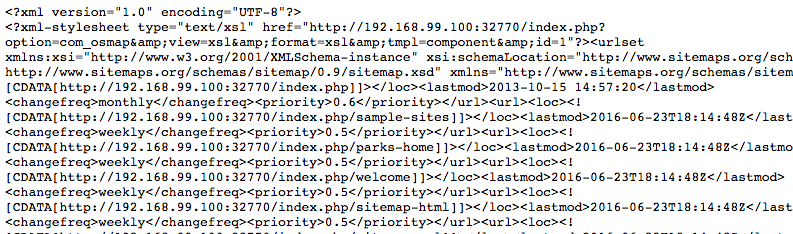
Understanding the XML Debug Output
The XML Debug view shows every sitemap entry exactly as OSMap generates it. This allows you to verify that each page includes the correct metadata.
<loc>: The URL that will be submitted to search engines. Verify that each URL is correct and points to the expected page.
<lastmod>: The date when the page was last modified. If this value is missing or incorrect, search engines may not recognise when the page has been updated.
<priority>: The priority assigned to the page within the sitemap. Check that the value matches your expectations for the page's importance.
<changefreq>: The expected frequency with which the page changes. This value provides search engines with a hint about how often the page's content is likely to be updated.
What to Look For
- Unexpected HTML before the XML declaration.
- Broken or malformed XML tags.
- Invalid or incorrect URLs in
<loc>. - Missing or incorrect
<lastmod>values. - Unexpected
<priority>values. - Unexpected
<changefreq>values.
Disable Debug When You're Finished
Debug mode is intended for troubleshooting only and displays technical information that is not useful to visitors or search engines.
Once you've finished investigating the problem, return to the menu item and set Debug back to No.